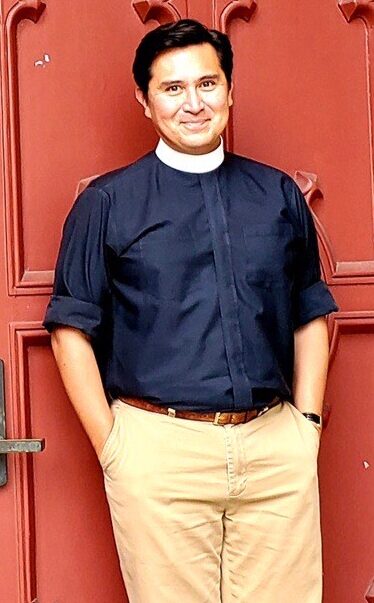
Sunday Sermon
November 23, 2025
The Rev’d Michael J. Horvath
Colossians 1:11-20; Luke 23:33-43
Christ the King Sunday always feels a little ironic. The name sounds triumphant, like we
should be unfurling banners and polishing crowns. But instead of giving us a victory
parade, the lectionary marches us straight to Golgotha. Instead of a king seated on a
throne, we get a man nailed to a cross. Instead of regal robes, he’s stripped naked.
Instead of loyal subjects, he’s surrounded by soldiers laughing at him.
And the church has the audacity to look at that scene and say, “Here. This one. This
crucified one is our king.”
It’s a bold claim in any age, but especially in ours, when the world is understandably
suspicious of power. People have protested against monarchs and other leaders for
centuries. Typically because they’re tired, amongst other reasons. Tired of being
disappointed by leaders. Tired of watching power get twisted into something that hurts
the vulnerable. Tired of human beings deciding that authority means having the right to
dominate. And if that’s what kingship is, then “No Kings” makes perfect sense.
And honestly, this isn’t a new impulse. It’s ancient. There is a scene in 1 Samuel where
the people beg the prophet for a king – not because God isn’t already leading them, but
because they want a king like everyone else has. A king who will look strong, act
decisively, give them a sense of control. Samuel warns them, in painful detail, what that
will cost: their sons, their daughters, their labor, their freedom. But still they insist. They
want visible power, predictable power, power that can be wielded. They want the kind of
kingship that takes. And God – almost heartbreakingly – lets them have it. “If an earthly
king is what they want, an earthly king they will get.”
And honestly that’s the human story: we keep asking for leaders who look powerful in
the ways we recognize, and then we’re shocked when that same power devours us.
But Christ the King Sunday isn’t about shoring up authority or baptizing those old
patterns of rule. It’s about redefining power altogether.
Paul’s soaring language in the letter to the Colossians paints Christ as the one in whom
all things hold together. The image of the invisible God. The one through whom the
galaxies came to be. It’s big, cosmic, uncontainable language, and it’s supposed to
make us catch our breath.
But then Luke shows us this same Christ bleeding on a cross. And nothing about that
looks cosmic or royal. It looks like failure. It looks like humiliation. It looks like everything
we think a king should never be.
And that’s the collision point: Christ’s kingship is completely unintelligible by the world’s
definitions. It’s not a nicer version of regular power. It’s a different kind of power entirely.
Human kings – human leaders of any kind – tend to build their authority on force,
charisma, brilliance, or fear. They work to stay in control. They gather influence. They
protect their image. They make sure their world is arranged so that they always come
out ahead.
But Christ stands in front of all that and simply refuses to play the game.
When he’s mocked – “If you’re the king, save yourself!” – he doesn’t take the bait.
Because saving himself would prove their definition of kingship correct. It would make
him just another figure who uses power to avoid suffering. Another ruler who stands
above the people rather than with them.
But he came to show us something we never would have imagined on our own: real
power is not the ability to avoid suffering; it’s the ability to love in the midst of it. Real
kingship is not about self-protection; it’s about self-giving. Real authority is not
domination; it’s mercy.
That’s what makes the moment with the criminal beside him so stunning. In a scene
filled with jeers and cruelty, one person finally sees something different. He doesn’t ask
Jesus to flex his power. He asks only to be remembered. And Jesus – this dying king –
answers not with pity or vague hope but with an immediate, intimate promise: “Today
you will be with me in paradise.” No prerequisites. No corrections. No proving himself. It
is all grace and invitation.
If you want to know what kind of king Jesus is, that’s the picture: a king who uses his
last breath to welcome someone nobody else would bother to save.
Christ’s kingship is not a theory. It’s not a metaphor. It is the way God actually chooses
to rule the world: through forgiveness, through solidarity with the suffering, through love
so durable it outlasts cruelty and death.
And this is where the “No Kings” marches become strangely relevant. People aren’t
wrong to distrust the versions of kingship they’ve seen. They’re not wrong to push back
against leaders who harm more than they heal. Americans have been doing that since
the Revolutionary War. What they’re rejecting is the very thing Jesus came to dismantle:
the assumption that power exists to serve itself.
When the world says, “No Kings,” maybe we can hear in it an ache for a better way. A
longing for a kind of authority that doesn’t crush or coerce. A hunger for leadership that
is trustworthy, humble, and oriented toward the healing of the broken.
And maybe, without shouting, without defensiveness, without triumph, the church can
gently say, “We’re with you. We don’t want those kings either. But we know a different
one.”
Because Christ’s kingdom is not an empire. It’s not a political structure. It’s not a
morality test or a purity code. Christ’s kingdom shows up wherever love is chosen over
fear. Wherever mercy upends shame. Wherever reconciliation replaces revenge.
Wherever the vulnerable are protected and the outsiders are pulled close.
Christ reigns whenever forgiveness happens.
Christ reigns whenever bread is shared and no one goes hungry.
Christ reigns whenever someone who feels beyond hope hears, “Today you are with
me.”
Christ reigns wherever life rises out of death, even the small deaths we carry around
inside us.
You don’t need to look at the thrones of this world to find the king. You look at the cross.
You look at the places where compassion is costly and still offered. You look at the
cracks in your own life where grace somehow keeps getting in.
The truth is, Christ’s kingdom is already breaking into the world, not with fanfare but with
quiet persistence. Not by overpowering but by outloving. And trust me, that kind of
kingdom can’t be marched against, because it’s not imposed. It’s invited. It’s received.
It’s lived.
So on this Christ the King Sunday, we proclaim something the world still finds
outrageous: that the crucified one—not the strong, not the violent, not the
triumphant—is the king of everything. And the kingdom he brings is the one our souls
have been aching for whether we know it or not.
A kingdom where mercy is the currency.
Where welcome is the language.
Where love is the law.
Where even the dying thief finds his way home.
Amen.