Sunday Sermon
Sermon for All Saints’ Sunday
November 2, 2025
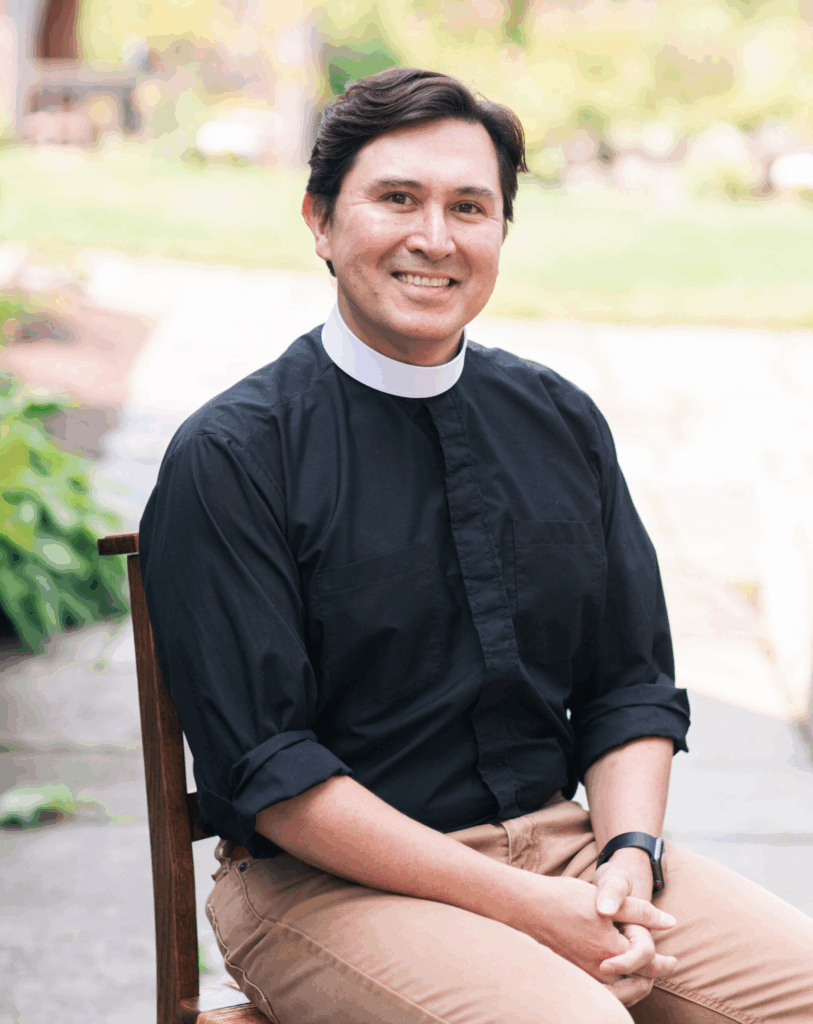
The Rev’d Michael J. Horvath
You know, every week we say in the Creed, “I believe in the communion of saints.” It’s one of those lines that sounds lovely and holy, but it should make us wonder what exactly we’re signing up for. The Communion of Saints isn’t a secret club of extra-holy people with halos and perfect hair. It’s not the VIP section of heaven. It’s the living, breathing, ongoing community of all God’s people — past, present, and future — who are knit together in love through Christ.
And All Saints’ Sunday is when we take the time to especially remember that. The day we say names, light candles, and remember the people who helped us glimpse something holy — even if they occasionally drove us a little crazy while doing it.
We call them saints. And I don’t mean just the ones with official titles and fancy feast days — I mean the ones who make the fabric of lives full and interesting: the grandparent who always made sure you had enough to eat, the friend who called when you were feeling alone. It’s the everyday saints that seem to make the greatest impression on us.
Saints are the people whose love made God’s love visible — the ones we’ve looked to for comfort, for protection, for good news when the world felt like it was falling apart. They’re the ones who, in their own messy, human way, made grace real.
But before there were saints with statues and stained glass, there were just people — like these regular, tired, worried people standing on a hillside today, listening to a carpenter with a knack for saying things that didn’t make any sense. “Blessed are you who are poor. Blessed are you who are hungry now. Blessed are you who weep.”
If you or I had been there, we probably would’ve looked around and said, “Hey Jesus, maybe check your notes. You might have mixed up the blessed and the cursed.” Because the folks in that crowd didn’t feel blessed. They were broke, hungry, grieving, and exhausted.
For many years I had not a very well formed understanding of Jesus’s words as a kind of demand – as if he were asking us to find virtue in our suffering or to measure the depth of our pain before we could call ourselves blessed. It felt as though blessing was always just beyond reach. But over time I’ve realized that Jesus wasn’t prescribing an attitude; he was revealing a truth about God’s world — that blessing doesn’t trail after power or success but rises in the places where people are hurting. And the truth — the reality — is that God’s heart beats in time with those who are barely hanging on. The ones the world overlooks are the ones closest to God’s own heart.
And that’s where the saints come in. Because the saints are the ones who have always trusted that if God shows up among the hungry, the grieving, and the weary — then that’s exactly where we belong too. They heard Jesus’ blessing not as a pretty sentiment, but as a call to action: “If that’s where God’s love is found, then let’s go there.”
Saints didn’t just admire Jesus’ words; they acted on them. They took seriously the call to feed the hungry, comfort the grieving, stand with the poor, and love the people everyone else had given up on. Saints have always been the ones who look at the pain of the world and say, “Yep, this is exactly where Jesus would be hanging out.”
Which brings us to today — All Saints’ Sunday, 2025 — and to some hard truth that doesn’t fit neatly on a Hallmark card.
Because as of yesterday, millions of Americans lost their food assistance. SNAP benefits — the thing that keeps food on the table for tens of millions of people — are being cut or suspended because of the government shutdown.
That’s not a theoretical issue; that’s real-life hunger. It means families are deciding between groceries and rent. It means seniors on fixed incomes are stretching cans of soup across the week. It means children are going to bed with stomachs growling while our politicians argue about whose fault it is.
If Jesus were standing on a hillside today, he wouldn’t need a metaphor. He’d just say, “Blessed are you who are hungry now,” and half the country would raise their hands.
These are the people Jesus is talking about in Luke today — the poor, the hungry, the grieving, the forgotten. Not because hunger or poverty are holy, but because God shows up where the need is greatest.
And if God shows up there, then we who claim to follow Jesus — we who are part of this messy, beautiful communion of saints — are called to show up there too.
To be a saint, in the truest sense, doesn’t mean you have to float two inches off the ground or spend your life humming Gregorian chant. It just means you let the love of God spill out through you. It means you act like the kingdom Jesus talked about is actually possible.
And here’s the thing that gives me hope: this week, when I asked you all to think about how we at St. Mary’s could respond to the growing food insecurity around us — how we could help feed the hungry in real, tangible ways — so many of you reached out. You didn’t just nod politely and move on. You called. You emailed. You dreamed. You came up with new ideas, new energy, new partnerships. You said, “We can do something.” You mobilized and you can see the fruits of your works in boxes of food you all brought in this weekend.
And I thought: There it is again. Jesus showing up. Not in a cloud of incense or a booming voice from the heavens, but in the kitchen conversations, in the pantry plans, in the hearts of his people deciding that someone else’s hunger is our concern.
And when we offer our loaves and fishes – our cans and gift cards and volunteer hours – God still multiplies them. When we share what we have, when we give a little time or a little love, blessings multiply. That’s how the saints keep showing up: through us.
So today, as we light our candles and say the names of those who’ve gone before us, let’s remember that the communion of saints is not a club we admire from afar — it’s a community we belong to. It’s made up of people who believed that God’s love is for everyone and lived like it.
Sainthood is about saying yes to the kind of love that looks ridiculous and impractical but somehow keeps saving the world.
So maybe this week, when you find yourself in the grocery store with a full cart, whisper a prayer for those who don’t have enough. Maybe throw in a few extra cans for the food pantry. Maybe remember that Jesus’ “blessed” and “woe” are not distant words on a page but living invitations to action.
And if you ever start to feel too small or too ordinary for all that — good. You’re in excellent company. That’s where every saint starts.
So, here’s to the saints — past, present, and yet to come. Here’s to the people who keep love alive in a world that keeps forgetting it. Here’s to you — taking your place in the great communion of God’s mercy.
Amen.