Sunday Service
Sermon for the Second Sunday of Christmas
January 4, 2025 Yr A
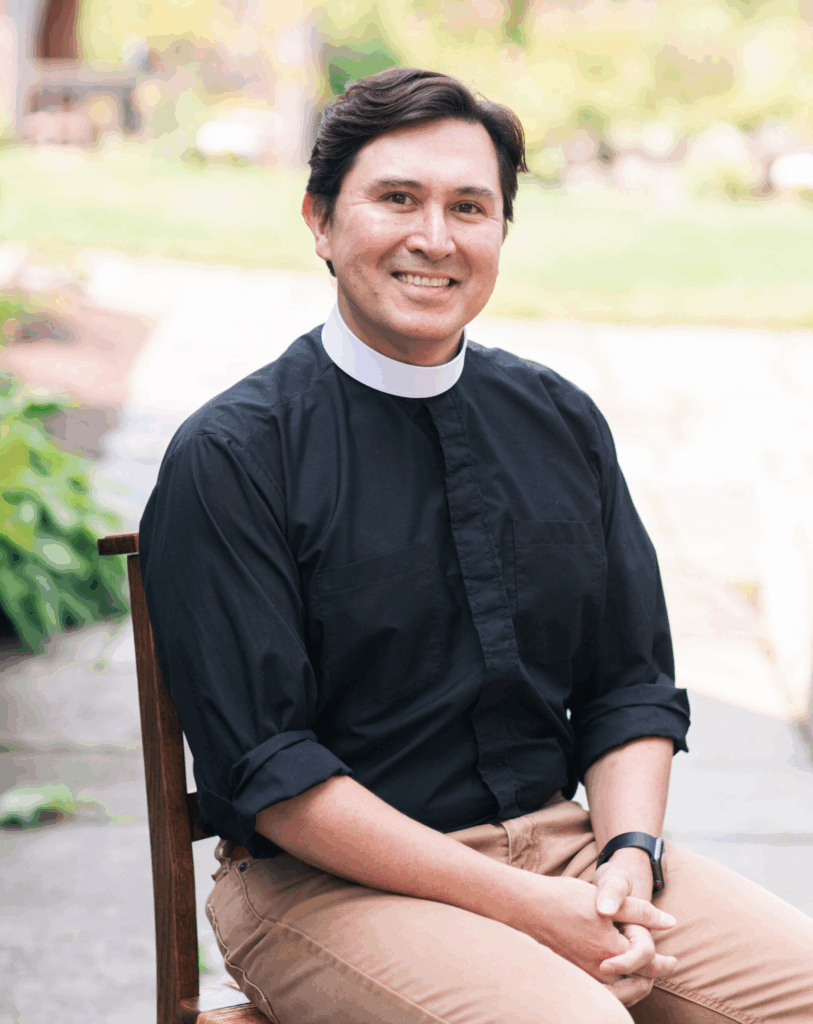
The Rev’d Michael J. Horvath
Gospel: Matthew 2:13-15,19-23
There’s something in us—especially those of us who love church, who organize our lives around liturgy and calendars and carefully planned worship—that really wants God to be settled. Housed. Predictable. Preferably stationary. We want God enthroned, framed, properly located. We want God to stay put so we know where to find God, and maybe more importantly, so God doesn’t wander off into places that make us uncomfortable.
And then this story shows up and absolutely ruins that fantasy. Because almost as soon as God shows up in the flesh, God is already on the run. Not metaphorically. Not spiritually. Literally. Bags packed. Plans changed overnight. The holy family doesn’t get time to settle in, doesn’t get to catch its breath, doesn’t get the Hallmark version of happily ever after. The incarnation barely clears its throat before it is
already moving, hiding, slipping across borders, trying not to be noticed. God-with-us becomes God-on-the-run. And that matters. It matters more than we sometimes want it to.
Because it tells the truth about where God chooses to be found. Not in safety. Not in certainty. Not in the places where everything is secure and accounted for. God shows up in vulnerability and then immediately enters danger. God does not hover above the chaos offering moral commentary. God goes straight into it and then has to flee for survival. Which is not exactly the brand of religion most of us
are looking for when we come to church hoping for a little reassurance and a decent
cup of coffee.
And here’s where this gets interesting—especially for church people. If the only time you come to church is Christmas and Easter, then the only Jesus you ever really meet is either adorable or invincible. You get the baby in the manger—soft lighting, excellent soundtrack, very photogenic. And you get the risen Christ—victorious, triumphant, death-defeating, wrapped in lilies and brass music. Which, honestly, are
fantastic Jesuses. Five stars. No notes. But they’re not the only Jesus.
When we only drop in for the big hits, we miss the middle of the story. We miss the Jesus who lives between the miracle moments. We miss the God who doesn’t sparkle so much as scramble. The God who hides. The God who runs. The God who spends more time figuring out where to sleep than delivering inspirational one-liners. Christmas gives us a God who arrives. Easter gives us a God who overcomes. But this story gives us a God who survives. A God who has to leave in order to live. And if we
skip over that part, we end up with a version of faith that looks great on a greeting card
but isn’t much help when life starts unraveling.
Because most of us don’t actually live in Christmas joy or Easter victory. We live in the
in-between. We live in the long, messy middle—between hope and disappointment,
between promise and fulfillment, between “everything is fine” and “well, this escalated
quickly.” And if the only God we know is the one who shows up for the grand entrance
and the big finale, then faith can start to feel a little disconnected from real life.
But this story insists that God is right there in the middle with us.
God’s life begins not in triumph but in threat. The first response of empire to God-in-the-
flesh is not applause but panic. God doesn’t just become inconvenient later on when
teachings get challenging. God is already a problem just by existing. Before a single
sermon is preached, the powers of the world have decided that this God is dangerous.
Which tells us something important about how power works. And about how God works.
Power wants control, predictability, clear lines of authority. God, apparently, is willing to
be small, hunted, and dependent on the obedience of people who don’t get a detailed
explanation or a five-year plan. Who does God entrust the future of salvation to? Not to
armies or institutions, but to a family that listens for direction in the dark and then
actually acts on it.
This isn’t heroic faith. It’s tired faith. It’s the kind of faith that says, “I don’t totally
understand what’s happening, but staying here feels worse.” It’s the kind of obedience
that doesn’t feel dramatic so much as urgent. The kind that involves disruption and loss
and letting go of the life you thought you were going to have. And that’s where God is.
Which is both comforting and, frankly, a little annoying.
Because if God is found on the run, then God is not limited to sanctuaries or moments
of calm. God is present in the lives of people who are displaced, uprooted,
undocumented, unsafe. God doesn’t just care about them from a distance; God knows
that life from the inside. God knows what it is to leave because staying would mean
death. God knows what it is to rely on strangers, to live without guarantees, to move
forward fueled mostly by hope and adrenaline.
And this isn’t only about refugees in the headlines. It’s about anyone whose life has
been suddenly turned upside down. Anyone who has had to walk away from something
not because they wanted to, but because they had to. A relationship that ended. A job
that disappeared. A diagnosis that changed everything. A truth about yourself that finally
demanded honesty and made the old life impossible.
We don’t usually label those moments as holy. We call them failures or detours or things
we’d really rather not talk about. But this story suggests that God does some of God’s
best work precisely there—not when everything is settled, but when everything is in
motion.
Which might explain why a faith built only on the highlight reel can struggle when things
get hard. A God who only appears in glory doesn’t know what to do with your fear. But a
God who has been on the run knows exactly how to walk with you through it.
And no, this doesn’t mean suffering is good or that fear is somehow virtuous. Being
hunted is not holy. Violence is not redemptive. Fear is not a spiritual achievement. What
is holy is that God does not abandon people in those moments. God doesn’t cheer us
on from a safe distance. God shows up in the thick of it, breathing the same anxious air,
trusting the same fragile path toward life.
Faith, according to this story, isn’t about staying put and believing the right things. It’s
about movement. It’s about responding when life nudges—or shoves—you forward.
Faith is not certainty; it’s trust with shaky knees. It’s waking up in the middle of the night
and realizing that obedience looks less like confidence and more like courage mixed
with caffeine.
We want God to be the anchor that keeps everything steady. But sometimes God is the
nudge that says, “It’s time to go.” Sometimes God is not the calm in the storm but the
voice that gently, persistently says, “You can’t stay here anymore.”
And here’s the surprising good news. If God is on the run, then God is also on the move
ahead of us. Which means we don’t have to have everything figured out before God
shows up. We don’t have to arrive somewhere stable before we’re worthy of God’s
presence. God is already there in the leaving, in the packing up, in the holy
awkwardness of what comes next.
So if you find yourself on the run from something that no longer gives life, you are not
outside the story. You are right in the middle of it.
And God is not watching from a distance.
God is running with you.
Amen.