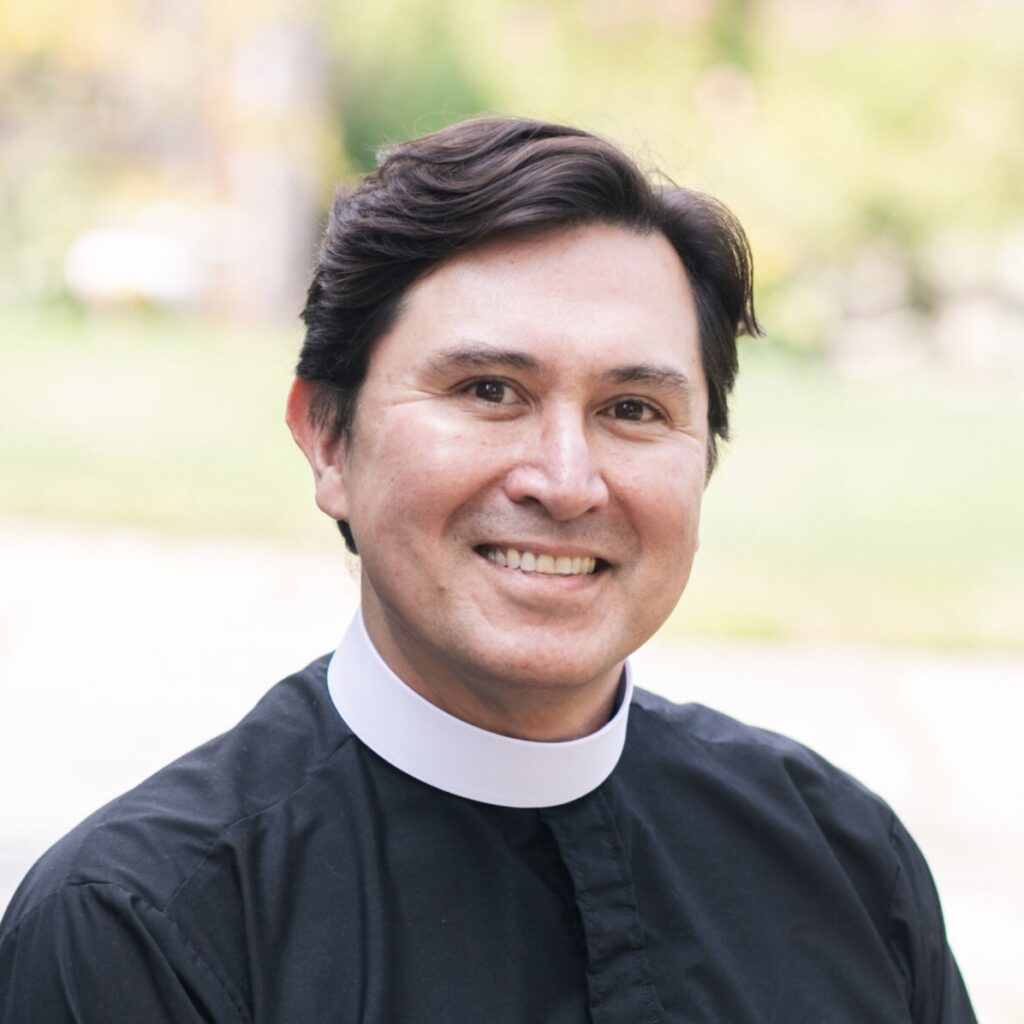
Sunday Sermon
May 3, 2026
The Rev’d Michael J. Horvath
Gospel: John 14:1-14
It is a strange and wonderful thing to discover something new about someone you have loved for years. You would think that after enough time together, you would have them figured out. The stories have been told. The habits are familiar. You know how they take their coffee, what they will say in certain situations, the expressions that cross their face before they even speak.
And then something happens.
A memory comes up that you have never heard before. They respond to something in a way that surprises you. They say something that makes you stop and think, “Wait… I didn’t know that about you.”
Even after all this time, there is still more there.
I have that experience with Charles. He’ll say or do something that leaves me scratching my head and thinking “How did I not know this about you in the almost 30 years with been together?” It’s not that I’ve been inattentive to Charles, but it reminds me that knowing another person is not something you finish. It is something you stay in. It deepens over time. It asks something of you. You have to keep paying attention. You have to stay open. You have to allow the possibility that the person you love is still, in
some ways, a mystery to you.
That experience opens up this moment in the Gospel in a way that feels almost uncomfortably close to home. Jesus turns to Philip and says, “Have I been with you all this time, and you still do not know me?”
Philip has been right there. He has listened to Jesus teach. He has watched him heal. He has traveled with him, eaten with him, seen the crowds gather and the quiet moments in between. If anyone should know who Jesus is, it should be Philip. And yet he says, “Show us the Father, and we will be satisfied.”
And Jesus responds, in essence: You have seen me. You have been with me. What more are you looking for? This exchange reveals how easy it is to be close to someone and still not really see
them.|
Proximity is not the same thing as recognition. It is possible to spend time in the presence of Christ and still miss who he is. That is not just Philip’s problem. It reaches into our own lives as well. We speak about
Jesus. We organize our lives around him. We gather in his name week after week. And yet there are moments when the Jesus we are talking about feels very different from the Jesus we encounter in the Gospels.
Part of what is happening is that we never come to Jesus as blank slates. We bring our assumptions, our experiences, our fears, our hopes. Over time, we form a picture of who we think he is. And that picture can become so familiar, so settled, that we stop noticing how much of it has been shaped by us.
We begin, often without realizing it, to rely on a version of Jesus that fits comfortably within the world as we already understand it. You can see that not just in individual lives, but at a much larger scale. Jesus’ name gets attached to all kinds of things. It gets woven into political identity. It is used to bless national projects. It shows up in language that justifies turning away from the vulnerable, or elevates power and dominance as if they were signs of faithfulness.
And when you step back and look at it, the shape of the life being described bears very little resemblance to the one we see in the Gospels. Which is why Jesus’ words here matter so much. “I am the way, and the truth, and the life.” Because Philip is looking for clarity. He wants something that will settle the uncertainty.
Show us God. Give us something definitive.
And Jesus offers himself. “I am the way.”
The way is already visible in how he lives. In how he moves toward people others avoid. In how he crosses boundaries others keep firmly in place. In the way he notices those who are overlooked. In the way he serves. In the way he loves, even when that love costs him something. If those words are separated from that life, they lose their meaning. And then Jesus says something even more startling.
“Very truly, I tell you, the one who believes in me will also do the works that I do.”
Which means that belief, in the way Jesus is speaking about it, is not simply a matter of recognition. It is not just about knowing who he is. It is about becoming aligned with how he lives. Knowing moves toward resemblance. It is one thing to say we believe in Jesus. It is another thing to find our lives gradually taking on the shape of his life. To notice that we are being drawn toward the same people. That we are responding with the same kind of mercy. That we are loosening our grip on the kinds of power he refused.
That kind of change does not happen all at once. It unfolds slowly, often in ways we do not immediately recognize. It asks for attention. It asks for honesty. It asks us to notice where the Jesus we claim to follow and the lives we are actually living begin to diverge. Which brings us back to that question: “Do you still not know me?” It would be easy to hear that as frustration. But there is something else in it as well.
There is an invitation.
An invitation to look again.
To set aside, even briefly, the version of Jesus we have grown comfortable with and return to the one we actually meet in the Gospels. To pay attention to how he moves, who he notices, what he values, where he goes. Because the truth is, we are not so different from Philip. We want clarity. We want certainty. We want something that confirms what we already hope is true . And Jesus keeps pointing us back to something both simpler and more demanding.
Look at how I live. Look at how I love. Stay there. Follow that. To know Jesus is not to arrive at a final, fixed understanding. It is to remain in relationship. It is to keep listening. It is to allow ourselves to be surprised, even after years of faith.
It is to notice where he continues to show up, often in places we would not have thought
to look, often in people we might have passed by. And it is to allow that knowing to take shape in how we live. In the choices we make. In the way we speak to one another. In the way we respond to what is happening around us. In the quiet, ordinary decisions that, over time, begin to form a life.
What I love about this Gospel is that the question “Do you still not know me?” is not the
end of the relationship. It is part of its deepening.
Because alongside that question comes a promise. If you trust me, if you stay with me, if you let your life be shaped by mine, you will do the works that I do, and you will see the Father. Our hands can do a lot of damage in this world, but I love the hopeful idea that when we are living like Christ, our hands are capable of being holy instruments of the divine.
Which means this is not only about seeing Jesus more clearly. It is about becoming part of how his life continues to take shape in the world. About participating in that same movement of love. That same drawing near. That same way of being with others. And that is a lifelong process.
Because even after all this time, there is still more to see.
And more to become.
Amen.